“Scientists Solve Andes Crater Mystery”
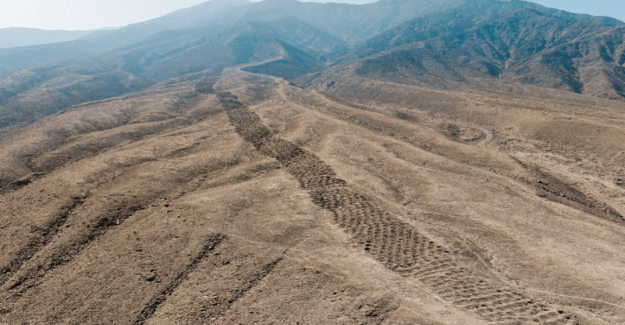
Monte Sierpe, or ‘Serpent Mountain’, is a stunning archaeological site in the Pisco Valley in southern Peru. Researchers have been puzzled for over a century about the more than 5,000 craters that stretch for nearly a mile on this mountain.
In 1933, National Geographic’s aerial photographs first brought the site to light. But the craters have long been a mystery, with no written evidence. Researchers have speculated that the craters were used for defense, accounting, food storage, gardening, or collecting water from the mist. Even proponents of the alien theory have speculated about the craters.
Scientists have come up with a new explanation in a recent study. Using drone footage and pollen analysis of the craters, the researchers concluded that they were once a bustling market area before the Inca Empire. Later, the Incas used them for accounting or tax collection. The study was published in the journal Antiquity on November 10.
“Why did ancient people dig more than 5,000 holes in the hillside? We still don’t know the definitive answer, but the new data is giving us important clues,” said Dr. Jacob Bongers, who led the study.
New Horizons in Drone Technology
Each of the holes is about 1 to 2 meters wide and half a meter to 1 meter deep. Drone images show that they are divided into about 60 separate sections, with spaces between each section. In one section of the 12 rows, rows of seven and eight holes were seen alternately—which is not random but indicates a clear and organized plan.
Microbotanical analysis found pollen from maize, wild grasses, reeds, and willow species in the holes—which were commonly used to make baskets. The researchers believe that products brought to market were either placed in baskets or laid out in leaves in the holes.
Before the Inca Empire, the people of the Chincha kingdom came here to exchange goods such as corn, cotton, coca, and chili. The pits then functioned as ‘units’. For example, if a certain number of pits contained corn, a certain number of pits filled with cotton or coca would be obtained in exchange.
‘Accounting ledgers’ during the Inca period
The pits are thought to be 600–700 years old. Citrus pollen found at the site indicates that the site continued to be used during the Spanish colonial period (1531–1825). However, the site was gradually abandoned as these pits could not fit into the Spanish economic structure.
According to researchers, the pits expanded during the Inca period and were used as a kind of massive accounting system. The Incas kept records using knotted ropes called ‘quipu’ – a similarity can be found in the layout of Monte Sierpe.
Answers still to come
Experts say the proposals are intriguing but need more evidence. Still, it makes a big difference in understanding the economy and local heritage of the Andean civilization.
“The narratives we construct about local cultural heritage have real implications,” says Dr. Bongers. “So indigenous perspectives and archaeological evidence must be taken into account in constructing explanations.”